Frequently Asked Questions
The most important is we accept customer’s design orders only, there are no open designs to choose from, no stocks or over run items for sale either everything must be your own logo or designs.
What is the minimum order quantity?
We don’t set minimum order quantity, but quantity will directly influence the price. Surely, the larger quantity, the more favourable price.
Do you have goods in stock?
We do not have stock for sell as we mainly do the custom designs. Please email us your design, size, order quantity etc…, then we’ll help to turn them into classic actual products.
What metal plating options do you offer for your products?
We offer gold, silver and copper platings standard with our orders. For an extra charge, we can antique those standard finishes to give an aged look to your lapel pins. Antique finishes also help greatly when your design is mostly metal (die struck)as the darker recessed areas provide a greater contrast for text and fine lines.
What degree of after-sales service can you provide?
We care a lot about the after-sales service since what we focus is not one single order but the long term cooperation and development.
What file formats are accepted for images and artworks?
We prefer images to be in CDR or AI formats, if possible. Otherwise, we accept EPS.JPG, .GIF, .PNG, .PPT, .DOC, .PDF, .BMP, .TIFF and .PSD. Almost every format are available for us.
Are you able to manufacture metal products in different shapes?
Any shape is available. They don’t need to be circular, as traditional lapel pins are. Our galleries have some examples of unique shapes.
What is your payment terms?
We require 30% depoist before we start the order. Small amounts below in full payments will be appreciated because of the handling fee occurs every time.
Do you offer a "rush" service/fee?
We are pleased to try our best to meet your rush delivery time, so we don’t charge any rush service fee.
What is die casting?
Die casting is a metal casting process that is characterized by forcing molten metal under high pressure into a mold cavity. Once the mold cavity is filled, the pressure is maintained until the casting solidifies after cooling down. Then the half-finished products would be polished, electroplated and color-filled.
What is photo-etched?
Etching is a “chemical” process. It is also known as Photo Chemical Machining (PCM) and Photo Chemical Milling.
Process Overview
The material is dissolved when immersed in a chemical solution. It is an exceptional manufacturing process that produces the most intricate, burr-free, stress-free, high-precision profiles in a wide range of metals.
Key Advantages
1) Security: This procedure makes the resulting product very difficult to reproduce.
2) Flexibility: Photo etching makes both the product and its design more flexible.
3) Materials: Usually, 0.3mm to 0.8mm thickness brass is used.
What is imitation hard enamel?
Imitation hard enamel is invented in early 1990 and also named Soft cloisonne or synthetic cloisonne. It would be filled into the stamped metal first, and have polishing and electroplating afterwards. It is hard to tell the difference between real hard enamel and imitation hard enamel colors, but if you stab the color parts with knife point, imitation hard enamel colors will get visible marks, however real hard enamel colors won’t because hard enamel colors are as hard as tiles.
What is soft enamel?
Soft enamel is another common substitute for hard enamel and synthetic enamel. It differs in the color technique.
The colors are not completely filled in the recessed areas, making the metal borders much more visible. It is fired at low heat to seal the colors and provide a lustrous appearance.
Manufacturing Process
Both soft enamel and hard enamel are manufactured using the same initial procedure, but there is a slight variation in the drying process:
1)Drying: Instead of being subjected to intense pressure and temperature (as done for hard enamel), soft enamel pins are simply air-dried.
2)Airflow: A current of air is allowed to fall onto the wet paint to dry it.
This functional difference in the drying process is what distinguishes soft enamel pins from hard enamel pins, though the differences do not end there.
What is offset printing?
Offset printing is the workhorse of printing. Almost every commercial printer does it. But the quality of the final product is often due to the guidance, expertise and equipment provided by the printer.
Principle of Process
The core principle is that ink and water don’t mix.
1) Preparation: Images (words and art) are put on plates.
2) Dampening: These plates are dampened first by water, then by ink.
3) Adhesion: The ink adheres to the image area, while the water adheres to the non-image area.
4) The “Offset”: The image is transferred to a rubber blanket, and from the rubber blanket to paper.
That’s why the process is called “offset” — the image does not go directly to the paper from the plates, as it does in gravure printing.
What is silkscreen printing?
The silkscreen process offers the best solution for your pin when your designs require precise, color-on-color detailing. Generally speaking, silkscreen printing is also named as solid color printing and each block or area with only one color involved. Silkscreen printing can be made as many colors as your wish and the colors can be matched with nominated Pantone numbers. Same as offset printing, we’ll print your motif on the metal and then die cut each piece.
What is epoxy used for?
Epoxy usually will be applied to the items related with soft enamel colors, hard enamel and imitation hard enamel items will never choose epoxy. If you want your pins have domed surface, the epoxy resin would be an option for you. You could add epoxy on the surface of the pin, which could avoid the paint or color from flaking off and discoloration. However, the epoxy itself might oxidize and discolor after few years.
Which metal materials are available for producing lapel pins?
There are kinds of material that can be applied to custom lapel pins. Such as brass, copper, iron, stainless Steel, aluminum, pewter and zinc alloy. If you have no idea which material is better for your design, just drop an inquiry to us and we will offer our suggestion after evaluating your design, quantity, budget and delivery time, finally turning your ideas into affordable and eye-catching custom lapel pins!
What is Die stamped?
It is a process that Die Struck into the brass to form a design.
Process Overview
Die struck (or Stamping) includes a variety of sheet-metal forming manufacturing processes, such as:
1) Punching: Using a machine press or stamping press.
O2) ther Operations: Blanking, embossing, bending, flanging, and coining.
Key Characteristics
1) Production Stages: This could be a single stage operation where every stroke of the press produces the desired form on the sheet metal part, or it could occur through a series of stages.
2) Application: The process is usually carried out on sheet metal.
3) Common Materials: Usually, materials like brass, iron, etc. are offered.
What is Cloisonne?
The hard enamel (cloisonne) product is stamped from copper. First, imprint your design on the metal to make a mold. Both outline and cut-outs are cut off by another mold. Second, the colors are hand-filled into the inner side of metal lines with enamel material(cloisonne). After that, the products will be baked in the oven at 1472 Fahrenheit temperature scale for 2-3 minutes. These two steps insure that one color won’t be mixed up with others. Third, the product will be polished individually, and plated in gold /silver /nickel or other plated colors. Finally, each product will undergo a strict quality inspection before package, to ensure only the high quality product will be sent to the clients.
What is SEMI-CLOISONNE?
Semi-cloisonné, also called Synthetic enamel, Epola, or Imitation enamel, is a modern substitute for hard enamel.
The process is similar to cloisonné (Hard Enamel) except that a special liquid epoxy material is utilized to provide colors instead of the cloisonné color. Colors can be matched to Pantone Colors (PMS) in imitation enamel.
Imitation enamel replaced the cloisonné because of its similarity to hard enamel material, but it is shinier, lower cost, has a faster delivery time, and offers many more colors to choose from.
The imitation enamel surface is flat and smooth. Basically, it feels on the same level with your fingers, with the logo, text, and color design slightly raised. This emblem’s “rough feeling of baking” is significantly different from soft enamel.
What's the process of order?
–Send us inquiry->get quotation->our designer design drawing and send it to you for approval->payment done.
->open mold and make samples->deliver you samples or send you pictures of samples for approval->mass production.
What Is Antique Plating?
We use antique finish often on custom medals, coins etc. A dark wash is applied to the base metal and then the raised areas are buffed off. It gives the metal a distressed or aged look. We often use this electroplate finish on award pins or historical pins. This electroplate finish is also used a lot on custom medals. It helps cut down the shine on designs with a lot of plain metal. With bronze medals, we always antique them so that you can see the details easier.
What Size Metal Pins should I order?
The most common lapelpins sizes range from 0.75″ to 1.0″. Average team trading pin size is 1.75″. 90% of teams order 1.50″, 1.75″ or 2.00″ Custom lapel pins come in just about any size you want. Custom any shape or custom logos. Get the size that’s right for you.
Will I have different back option for attachment?
We offer variety of attachments for custom pins. A traditional butterfly or rubber clutch is usually the default attachment type. Another attachment upgrade options include a safety pin backing, deluxe clutch, or magnetic backing. If you want to upgrade, some buyers turn the custom lapel pins into cufflinks, money clips, keychains, tie clips, ring, necklace, letter openers, bottle opener..etc.
How should I provide artwork to you?
We need the details spec. / art/photo and quantity to offer you our best price! We highly recommend the use of PMS Matching System colors in your art in order to reproduce the colors you require.
***The most preferred format is Illustrator or .eps vector artwork and all fonts converted to outlines/curves.
***The photos for reference accept .jpg, .pdf, .tiff, .png, .psd or .bmp files (artwork should be at least 300 dpi or higher).
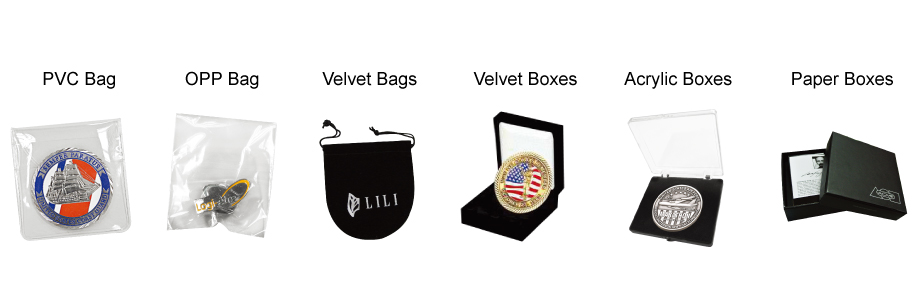
What coins package?
Can I change or cancel my order after in production?
We understand that unforeseen circumstances may arise, leading to the need for order cancellations. However, please note that any cancellations or changes are subject to charges based on the costs incurred up to the time of your custom pins request. These charges are necessary to cover the resources and efforts invested in processing your order up to that point.
No Changes Once Production Begins:
Once we commence the production of your custom giveaways, we cannot accept any further changes to the order. This is because our team immediately starts working diligently to bring your vision to life, and changes at this stage can disrupt the production process and impact the quality and delivery time of your pins.
New Order for Changes During Production:
If changes are necessary after the production has begun, it will be treated as a new order. This ensures that we can maintain the highest level of quality and efficiency in the production process. Our team will be more than happy to assist you in placing a new order for any modifications or additional required.
Clear Communication for a Successful Project:
To avoid any confusion or inconvenience, we encourage open communication from the start of the project. Please provide us with all necessary details and specifications before production begins, so we can ensure a smooth and successful process for your custom giveaways.
Streamline your custom medal order. Our FAQ covers design specs, bulk pricing, shipping times, and artwork setup to ensure a smooth and successful experience.